


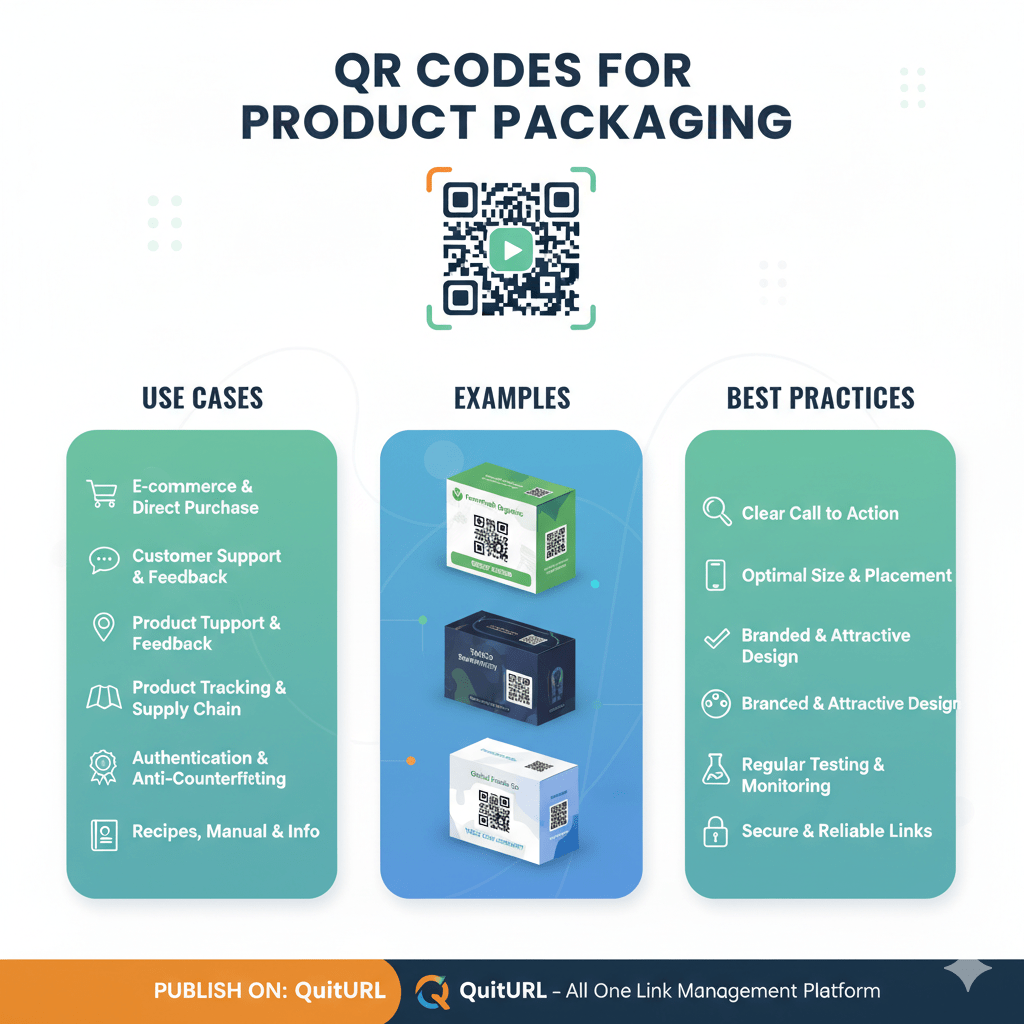
QR Codes on product packaging make it easy for brands to share information, verify authenticity, and connect customers to digital experiences instantly. They turn ordinary packaging into an interactive communication tool that boosts trust, engagement, and conversions.
Today’s customers expect more than labels. They want transparency, guidance, authenticity, and meaningful digital touchpoints. QR Codes deliver this without increasing packaging space or printing costs. With dynamic QR Codes from platforms like QuitURL, brands can update links anytime, track performance, and create personalized digital experiences — all from one place.
As ecommerce accelerates and customer expectations shift, QR-enabled packaging has become essential for brands in FMCG, skincare, electronics, supplements, fashion, and beyond. This article explores how QR Codes work on packaging, where to place them, real-world use cases, compliance standards like GS1, and best practices to ensure high performance.
What Are QR Codes on Product Packaging, and Why Should You Use Them?
QR Codes on packaging are scannable codes printed on boxes, labels, wrappers, or containers. They connect customers to digital content instantly—such as instructions, authenticity checks, videos, manuals, or loyalty programs. Brands use them because they enhance transparency, reduce printing clutter, and improve customer experience at almost zero cost.
Detailed Explanation
QR Codes on packaging work as a bridge between the physical product and a digital experience. Instead of printing long descriptions or complex manuals, brands can use a QR Code to direct customers to videos, guides, recipes, tutorials, or landing pages. This keeps the packaging clean while offering unlimited space for information.
A major benefit is real-time updates. Dynamic QR Codes allow brands to change the link behind the code anytime without reprinting packaging. This is valuable for product recalls, compliance updates, regional content, and seasonal campaigns. A skincare brand, for example, can update ingredient details as formulas change.
Brands also use QR Codes for transparency and trust. Customers scan codes to check batch numbers, verify authenticity, or confirm sourcing information. This is especially critical for supplements, beauty, electronics, and luxury goods.
From a marketing standpoint, packaging QR Codes help brands build post-purchase engagement. They can link to:
- onboarding guides
- loyalty enrollment
- subscription programs
- social media
- registration forms
- UGC campaigns
Because QR Codes are trackable, brands gain insights into customer behavior—scan locations, device types, repeat scans, and more. Platforms like QuitURL provide analytics dashboards that help marketers measure engagement and optimize packaging strategies.
Finally, QR-enabled packaging reduces customer support load. Instead of answering repetitive questions, brands direct users to a centralized digital hub.
Where to Place QR Codes on Product Packaging
QR Codes must be placed in visible, scannable areas such as the front panel, back label, side panel, or seal area. The placement depends on the purpose—marketing QR Codes should be on the front or main panels, while compliance or informational codes fit best on the back or sides.
Detailed Explanation
Placement significantly affects scan rates. If the QR Code is tucked away or printed too small, customers simply won’t use it. The best locations align with natural user interactions.
Front panel placement
Brands use front placement for high-engagement experiences like campaign participation, AR experiences, or special offers. Because it’s immediately visible, it gets the highest scan rate.
Back or side panel placement
These surfaces are ideal for instructions, ingredients, manuals, or authenticity checks. Customers naturally look at these areas when exploring the product.
On labels or bottle wraps
For cosmetics, beverages, sauces, supplements, and essential oils, circular or curved surfaces require thoughtful positioning. The code should be centered on a flat surface to prevent distortion.
Outer packaging or shipping boxes
Ecommerce brands add QR Codes to delivery boxes to encourage repeat purchases, unboxing experiences, or installation guides.
On seals or warranty stickers
Electronics and luxury goods print QR Codes on tamper seals or authenticity cards. This encourages immediate scanning and reinforces trust.
Regardless of placement:
- Maintain at least 1 cm of white space around the QR Code
- Use high contrast (dark code, light background)
- Keep minimum size 2 cm x 2 cm (1 x 1 inch for retail distance)
- Avoid printing codes over curves or textures
- Never place QR Codes near barcodes unless required by GS1
Well-placed QR Codes make packaging more useful and instantly interactive.
What Are the Different Types of QR Code Packaging?
Product packaging uses multiple forms of QR Codes—dynamic QR Codes, static QR Codes, GS1 Digital Link QR Codes, authentication QR Codes, and promotional QR Codes. Each serves a different purpose, from compliance to storytelling to marketing.
Detailed Explanation
Static QR Codes
These codes have fixed URLs that cannot be changed once printed. They are ideal for permanent content such as brand websites or evergreen PDFs. However, they lack flexibility and analytics.
Dynamic QR Codes
Brands increasingly use dynamic QR Codes because they allow link updates anytime. This reduces reprinting costs and supports:
- seasonal campaigns
- product recalls
- multilingual content
- regional personalization
- A/B testing
QuitURL offers dynamic QR Codes with analytics, allowing marketers to track scans and optimize experiences.
GS1 Digital Link QR Codes
These packaging codes follow global standards and replace traditional barcodes. They offer multiple data points in a single scan—batch number, expiry date, serial ID, origin, and digital content.
Authentication QR Codes
Used in electronics, pharmaceuticals, luxury items, and supplements. Customers scan to verify authenticity, ensuring the product is not counterfeit.
Instructional or informational QR Codes
These codes link to tutorials, installation videos, recipes, or safety guides.
Promotional QR Codes
Used for marketing campaigns, user-generated content (UGC), loyalty programs, discount offers, and contests.
Smart packaging QR Codes
Used in IoT-enabled packaging where scanning triggers AR, AI experiences, or dynamic product journeys.
Each type plays a unique role in modern retail, allowing brands to create richer customer experiences.
GS1 QR Codes Are the Future of Product Packaging
GS1 QR Codes, also known as GS1 Digital Link codes, are replacing traditional barcodes. They allow brands to include product identifiers plus digital content in one scannable code. Retailers and governments worldwide are adopting GS1 as the new standard.
Detailed Explanation
Traditional barcodes only contain a GTIN (Global Trade Item Number). GS1 Digital Link QR Codes carry far more information:
- GTIN
- Batch/lot number
- Serial number
- Expiry date
- Product attributes
- Digital instructions
- Recall information
- Manufacturer authentication
This makes them essential for industries with compliance requirements—food & beverage, pharmaceuticals, baby products, electronics, and cosmetics.
Governments in the EU, US, India, and China are transitioning toward digital compliance labels. GS1 QR Codes unify the supply chain by providing all product data in a single, scannable format.
For retailers, GS1 codes reduce scanning errors, support self-checkout, and improve inventory accuracy. For consumers, they offer transparency and safety.
Brands should begin adopting GS1-compatible QR Codes now to stay ahead of regulatory shifts.
Use Cases for QR Codes on Product Packaging
Short Summary
QR Codes enhance packaging by offering transparency, digital experiences, and interactive content. Brands use them for instructions, recipes, authenticity, sustainability details, customer onboarding, and marketing campaigns.
Detailed Explanation
Here are the most common and high-impact use cases:
1. Product instructions and tutorials
Instead of printing long guides, brands link to videos, manuals, and product setup instructions.
Examples:
- Furniture assembly videos
- Skincare application routines
- Electronics unboxing and installation guides
2. Authenticity verification
Customers scan the QR Code to check whether the product is original. This protects revenue and builds trust.
Used heavily by:
- Pharma
- Electronics
- Supplements
- Luxury goods
3. Ingredient transparency and sourcing details
Consumers care about what they buy. QR Codes help brands share:
- full ingredient lists
- allergen details
- sustainability information
- farm-to-table sourcing
4. Recipes and serving ideas
Food and beverage brands use QR Codes to deliver recipes, pairings, nutrition info, and more.
5. Loyalty, rewards, and subscription programs
Scanning can automatically enroll customers into a brand’s digital ecosystem.
6. User-generated content (UGC) campaigns
QR Codes link to Instagram filters, TikTok challenges, or hashtag contests.
7. Product registration and warranties
Makes it easy for customers to register electronics or make warranty claims.
8. Sustainability and recycling instructions
Customers learn how to recycle each component of the packaging.
9. AR and immersive experiences
Beauty, toys, and apparel brands use QR Codes for AR try-ons or interactive product stories.
10. Customer support
Codes link directly to chat support, WhatsApp, or FAQs.
These use cases elevate packaging from static to interactive—strengthening the customer relationship.
Best Practices for Packaging QR Codes in Every Industry
To ensure high scan rates and usability, QR Codes must follow size, contrast, placement, and design best practices. Industries like FMCG, fashion, pharma, and electronics each have specific requirements.
Detailed Explanation
General Best Practices
- Use dynamic QR Codes for flexibility
- Ensure minimum size: 2 x 2 cm
- Keep high contrast (dark code on light background)
- Maintain 1 cm of quiet zone (white space) around the code
- Test scanability on multiple devices
- Avoid placing codes over curves or textured surfaces
FMCG & Food/Beverage
- Include recipes, ingredient transparency, allergen details
- Place codes on flat areas to avoid distortions
- Consider GS1 formatting for supply chain compatibility
Beauty & Skincare
- Use QR Codes for routines, ingredient lists, safety notes
- Include expiry details or batch verification
Electronics
- Use QR Codes for manuals, warranty registration, and setup videos
- Add security/authenticity verification
Pharma & Supplements
- Must comply with global regulations
- Link to dosage guidelines, safety warnings, traceability
Fashion & Apparel
- Use QR Codes for styling guides, sustainability info, care instructions
- Add digital storytelling for brand values
Luxury Goods
- Add authentication and traceability features
- Use tamper-proof QR sticker seals
By following these best practices, brands maximize usability and boost customer satisfaction.
Customer-Focused QR Code Best Practices
QR Codes should deliver value instantly. That means they must load fast, offer mobile-friendly content, and provide clear benefits for the customer.
Detailed Explanation
1. Make the destination mobile-first
Since QR Codes are scanned on phones, landing pages must be mobile-optimized.
2. Provide clear instructions
Add a short call-to-action such as:
- “Scan for instructions”
- “Scan to verify authenticity”
- “Scan for recipes”
3. Keep content simple and relevant
Customers expect immediate value—not long navigation.
4. Avoid linking to heavy PDFs
Replace with mobile webpages or videos whenever possible.
5. Use branded QR Codes to build trust
Custom colors and logos help customers recognize authenticity.
6. Update content dynamically
Ensure links stay current and useful.
7. Respect privacy
Do not collect unnecessary customer data after scanning.
Customer-centric packaging QR Codes lead to higher engagement and stronger brand loyalty.
Why QuitURL Is the Best QR Code Generator for Product Packaging
QuitURL offers a powerful suite of tools that make it ideal for brands creating QR Codes for product packaging. Built for marketers, ecommerce brands, and manufacturers, it provides:
Key Features
- Dynamic QR Codes (change links without reprinting)
- Custom branded QR Codes
- URL shortener for clean links
- Detailed analytics (location, device, scan count, timeline)
- CTA overlays for interactive landing pages
- Bio pages for tutorials, guides, and product hubs
- Deep linking for apps and mobile experiences
- API access for automated packaging workflows
- Team collaboration for marketing teams
- High uptime + security for enterprise needs
QuitURL is more than a QR generator—it’s a full intelligent link management system designed for modern brands.
FAQs About QR Codes for Product Packaging
1. Do QR Codes work on all types of packaging?
Yes. QR Codes work on boxes, labels, bottles, cans, wrappers, and even fabric tags as long as they’re printed clearly.
2. What size should a QR Code be on packaging?
The minimum recommended size is 2 cm x 2 cm, but larger sizes improve scan rates.
3. Can I change the link after printing the QR Code?
Only dynamic QR Codes (like those from QuitURL) allow you to update links anytime.
4. What should I link my packaging QR Code to?
Common links include instructions, verification pages, recipes, warranties, AR experiences, and loyalty programs.
5. Are QR Codes required for compliance?
Some categories—such as food, supplements, and pharma—are moving toward mandatory digital labeling standards like GS1 QR Codes.
6. Can QR Codes be branded with colors and logos?
Yes, but maintain high contrast and avoid interfering with scanability.
7. Will customers actually scan QR Codes?
Yes—QR usage has grown significantly post-2020. Studies show consumers expect interactive packaging.
8. How many QR Codes can I put on packaging?
Use one main QR Code for customer interaction. Additional QR Codes (e.g., GS1 codes) may be required for retailers.
9. Do QR Codes expire?
Static QR Codes do not expire. Dynamic QR Codes only expire if the provider terminates the link.
10. Can QR Codes help with sustainability?
Absolutely. They reduce the need for printed materials and provide recycling instructions digitally.
Conclusion
QR Codes have transformed product packaging into an interactive, informative, and customer-driven experience. From transparency and compliance to marketing engagement and storytelling, QR Codes offer limitless possibilities for modern brands. With standards like GS1 QR Codes shaping the future, now is the ideal time for brands to adopt smart packaging strategies.
Platforms like QuitURL make it easy to generate dynamic, trackable, branded QR Codes that elevate customer experience while giving brands full flexibility and analytics.
If you want to modernize your product packaging, start with a clear QR Code strategy, follow best practices, and choose a reliable generator that grows with your brand.